Monday, June 29, 2009
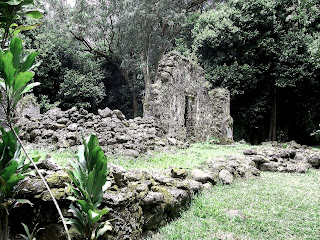
The Pali highway--between Honolulu and Kailua--is one of the main roads that leads from one side of the island to the other, well-traveled at any time of the day or night. It was very strange to be so near the highway that I could hear the whish-whish of tires on the pavement--close enough that I could have walked to the side of the road through the dense jungle. I thought of that line in one of Brother Iz’s songs: what would the ancestors say if they saw Hawai’i now? A modern roadway--following the pass through the mountains--near what was once a royal residence. How many people traveling across the island that day even knew the palace had existed? Not many. I had traveled that road countless times, having lived in Waimanalo for years, and not been aware. Secrets hidden--that’s what I’ve grown to think of Hawaii--so many secrets hidden--and in our modern life of rushing from one place to the other, we--I--fail to know what is just off the roadside, hidden in the forest, awaiting discovery.


Saturday, March 28, 2009

Thursday, January 22, 2009

Hawai'i
I had been so busy getting my grades posted for two community colleges that I really hadn’t paid much attention to the fact that I was once again heading to the island that I love: Oahu. The fact that while there my wardrobe consists of a swimsuit, beach towel, snorkel and fins never fails to make me smile. I threw two loose-fitting dresses in my suitcase and was off to the airport. Roxanne picked me up in the middle of the night—3:45 a.m.—before I (or the sun) was thinking about rising. I am used to the five and a half hour flight, so I just hunkered down in my seat. After a long snooze, I awoke from feeling something pulling on me—not on me physically, but on me psychically. I glanced at my watch, which had been set for local Hawaiian time, and I realized we were about an hour from landing. I felt the hands of the islands reaching out for me—drawing me closer to them, calling me home. It is as if an Auntie is standing at the top of the steps, her arms outstretched to greet me, welcoming me home. I stared out the window longing for the telltale clouds covering the Koolau Mountains, knowing we would soon be within sight of land. I remembered my house on the beach in Waimanalo and the many afternoons I spent in the shade of the ironwood trees, swinging in my hammock with Kaohikaipu Island and Makapu’u lighthouse in the distance. Tears welled up and I let them run down my cheeks as I recalled swinging my legs over the side of the hammock and burying my feet in the soft sand. We flew around the southern end of the island, made a right turn at Hanauma Bay and up the populated side of Oahu. The islands are sacred space—the a’ina—moving slowly northwest from the hot spot in the middle of the vast Pacific Ocean. Every time I come or leave the island, I feel a lifting of the veil, allowing me entrance to the special world of the spirits. It is palpable, and I welcome it as I fall into Pele’s embrace. As soon as I got off the plane, I headed for the women’s room, rip off my long pants and shoes and don my muumuu and slippers… aaahhhh… at home and free at last!
One morning I traveled across the Pali—rain beating down so hard that I could barely see the forest on either side of the road—to Waimanalo. I carried with me the graciousness of an old friend who, from Germany, had arranged a massage with a friend of hers. I was very thankful for the massage because my right knee had been giving me some problems, causing me to limp and list in a manner that was causing me some distress. I was anxious to have Christine work out the kink and get me standing up straight and tall again. She welcomed me to her home and bade be lie down on the table. I relaxed to her healing touch and let her manipulate my tired body. When I rolled over on my stomach and she began work on my back, I heard voices—low at first, as if the sound was coming from far away. Christine had some Hawaiian music playing in the background so just to be sure it wasn’t on the CD, I asked her if the song that was playing was an instrumental. “Yes,” she said. “Then they’re here,” was all I said as I sank into timeless space. As soon as I relaxed, the sound became clearer. I heard men’s voices chanting in Hawaiian. I could not make out any words, but the feeling was very soft, like the rain that began to fall, the drops hitting the leaves of the ti plants outside the open louvered windows. I don’t know how long it lasted for I had fallen through a crack of time and anything a clock would have shown me would have been “White Man’s time.” Just as gently as the voices came, they went, and then, were gone.
I was sitting on the lanai of my rental condo one evening, watching the lightening storm that was drifting across the mountains and over the Ewa plain. After a few minutes it dawned on me that I was not watching heat lightening—that these were jagged streaks and that they were heading in the general direction of the main power plant on the Waianae coast. The light in the kitchen behind me flickered once and I decided the smart thing to do would be to unplug my computer. I got up, shut down my laptop computer and put it away in its traveling case. I returned to the lanai, leaned back in my chair and watched the storm. Just a few minutes later all the lights in Waikiki went out. I had no hurricane preparedness kit: no candles--not even any matches--no transistor radio. I looked around and thought, “What’s the worst that can happen?” There was no place I needed to go, nothing I needed to do, so I simply sat and watched the traffic on Kalakaua grind to a snarling halt. Then my cell phone rang and I was able to use the ambient light from the parking garage across the street to find my purse. When I answered the phone, I expected it to be one of my friends in Honolulu, calling to ask if I was OK. Instead it was my friend Hiroe from Tokyo. “Are your lights out?” she asked right away. “You’re all the way across the Pacific and you know the lights are out? How weird is that?” I laughed. Instead of claiming the cosmic intelligence I tried to give her, she confessed that she had been talking to a friend who lives in Waikiki when the lights went out. She called me, knowing that I would think it was a pretty good joke. She told me that the lights were out on the whole island and wouldn’t be on any time soon. After we finished chatting, I sat on the lanai and was able to see the stars—something that is never possible in Honolulu, and especially in Waikiki, because of all the lights. Finally the deep black sky hypnotized me to the point where I felt I’d better crawl out of my chair and head for bed. The next morning I got up and flipped the switch—still no power at 6 a.m. The sun came up around 6:30, and having no running water (electric pump, I surmised) therefore no coffee and no toilet, I decided that was enough reason (and there was enough light) to make my way down the eight flights of stairs to the street. Tourists were scouring the shops in search of coffee and food, but not much was open at that hour—even Starbucks was closed. I went over to Kapiolani Park, knowing some friends would be meeting in the park and they would have all the answers to all my questions. Sure enough, they had the information about the power outage, when the lights were to be turned on, a hug and a freshly brewed cup of coffee. Ah, the Coconut Wireless… When I got back to the condo around 9:00, the light was blinking on the microwave—power restored. I threw out my small container of milk and checked the freezer. Although I understand that some businesses and homes were gravely effected by the loss of power, my loss was that my Melona ice cream bar had melted. Instead of eating it from the stick, I had to put it in a bowl and eat around the stick.
My dear friend Lani, who was raised on the slopes of the dormant volcano Haleakala (“House of the Sun”) of Maui, invited me to Mauna ‘Ala for He Ho’ohanohano No Ke Kuini Ema Kaleleonalani—the celebration for Queen Emma’s 173 rd birthday. It was drizzling rain in Waikiki that morning so I was positive it would be raining inland in the Nu’uanu valley. When we arrived at the mausoleum grounds, Lani handed me an umbrella and went to join her Daughters of Hawaii group. The Royal Hawaiian Band was playing under a canvas canopy while a beautiful wahine danced hula. Gentle rain began to fall as the crowd gathered. One elder couldn’t move her walker fast enough to get out of the rain, so I walked over and stood beside her with my umbrella over the top of both of us until she was rescued and taken under the canopy and given a seat next to a trumpet player. A soprano from the Kawaiahao churh shared her beautiful voice. Then the Daughters of Kamehameha, in their long black dresses and hats, proceeded up the steps of the chapel. The Daughters of Hawaii, in white, followed. When they were all in the pews on the right side of the chapel, everyone else left their shoes on the steps and entered on the left. Part of the gathering was to honor the board of the Queen’s Health Care systems. The service was short—not much mention was made of the Queen—and we exited the church in the order we’d come in. The hosts had seen to the orderly placement of shoes (much unlike the usual method of kicking off your shoes and leaving them by the door for everyone to trip over…). I was one of the last ones out of the chapel, but I heard the trumpeting of the conch shell as I was scurrying to put on my slippers. The gathering had gone around the side of the church to the granite monument, which stands behind the chapel. Representatives of the civic groups respectfully delivered leis to a man who then draped the garlands across the face of the tomb. Both while I was in the chapel and again when I was at the tomb, I asked for permission from the spirits that guard the islands to be allowed to speak about Hawaii in my next book.
After the ceremony at the monument, we went up to Queen Emma Summer Palace for a tea party. I had forgotten about the bookstore behind the Summer Palace but as soon as I saw it, I smiled and went inside. I was browsing through the books and piled a few on my arm for purchase. Who should come in but the lady with the walker. Evidently she remembered me being of assistance. “What kind of books are you interested in?” she asked. “History,” I replied. She turned to the cashier and said, “Give this woman my discount. My name is Auntie Mary.” And so, Auntie Mary’s kindness gave me the opportunity to buy two books for “free.” Lani had gone in to the room where we were to have a tea party and I came in just as they were saying the prayer. She had found us two seats at a table, and after we filled our plates we sat down to eat. At our table were three Hawaiian women: one told us she was 91, the second was 88, and the third (the youngest) had been raised on the island of Lanai. They started to “talk story” as the rain poured down. It was as if we had been transported to their lanai (in fact, one woman had lived next door to the Summer Palace most of her life)—we were all old friends who had stopped by to visit until the rain let up. One woman regaled us with story of meeting Madame Pele as she had been chased back to school after she and a friend had decided to play hokey one afternoon. That same auntie had worked for Lani’s uncle in the pineapple factory on Maui. Time stood still as they shared stories, each telling adventures that they had not been witness to, but had been passed down through their families. As in all good things, the end came too soon. Lani and I gave them our aloha, put up the umbrella and headed for her car. As we were driving away, I glanced at my watch what had seemed like visiting with those ladies all afternoon had not been that long. As they are able to do, the Hawaiians stopped time so that we could “talk story,” then catapulted us back into “White Man’s Time.”
When I think about leaving Hawaii, I start to get all choked up. It’s like I can’t bear the thought of stepping foot off the island—the Mainland is but a fairyland place that I had once been, but has faded into the mists like Avalon. All too soon the days rolled by and it was time for me to board the plane back to California. As the brave little soldier I can be, I strapped the seat belt around me and settled in for the red eye flight. We taxied down the runway and I was surprised that I wasn’t crying—usually the tears were flowing copiously by then. As the wheels left the runway, the tears started and it was all I could do to hold in a plaintive wail. The plane pierced the invisible veil at about 1,000 feet as I was whisked away into the starry night sky.
One morning I traveled across the Pali—rain beating down so hard that I could barely see the forest on either side of the road—to Waimanalo. I carried with me the graciousness of an old friend who, from Germany, had arranged a massage with a friend of hers. I was very thankful for the massage because my right knee had been giving me some problems, causing me to limp and list in a manner that was causing me some distress. I was anxious to have Christine work out the kink and get me standing up straight and tall again. She welcomed me to her home and bade be lie down on the table. I relaxed to her healing touch and let her manipulate my tired body. When I rolled over on my stomach and she began work on my back, I heard voices—low at first, as if the sound was coming from far away. Christine had some Hawaiian music playing in the background so just to be sure it wasn’t on the CD, I asked her if the song that was playing was an instrumental. “Yes,” she said. “Then they’re here,” was all I said as I sank into timeless space. As soon as I relaxed, the sound became clearer. I heard men’s voices chanting in Hawaiian. I could not make out any words, but the feeling was very soft, like the rain that began to fall, the drops hitting the leaves of the ti plants outside the open louvered windows. I don’t know how long it lasted for I had fallen through a crack of time and anything a clock would have shown me would have been “White Man’s time.” Just as gently as the voices came, they went, and then, were gone.
I was sitting on the lanai of my rental condo one evening, watching the lightening storm that was drifting across the mountains and over the Ewa plain. After a few minutes it dawned on me that I was not watching heat lightening—that these were jagged streaks and that they were heading in the general direction of the main power plant on the Waianae coast. The light in the kitchen behind me flickered once and I decided the smart thing to do would be to unplug my computer. I got up, shut down my laptop computer and put it away in its traveling case. I returned to the lanai, leaned back in my chair and watched the storm. Just a few minutes later all the lights in Waikiki went out. I had no hurricane preparedness kit: no candles--not even any matches--no transistor radio. I looked around and thought, “What’s the worst that can happen?” There was no place I needed to go, nothing I needed to do, so I simply sat and watched the traffic on Kalakaua grind to a snarling halt. Then my cell phone rang and I was able to use the ambient light from the parking garage across the street to find my purse. When I answered the phone, I expected it to be one of my friends in Honolulu, calling to ask if I was OK. Instead it was my friend Hiroe from Tokyo. “Are your lights out?” she asked right away. “You’re all the way across the Pacific and you know the lights are out? How weird is that?” I laughed. Instead of claiming the cosmic intelligence I tried to give her, she confessed that she had been talking to a friend who lives in Waikiki when the lights went out. She called me, knowing that I would think it was a pretty good joke. She told me that the lights were out on the whole island and wouldn’t be on any time soon. After we finished chatting, I sat on the lanai and was able to see the stars—something that is never possible in Honolulu, and especially in Waikiki, because of all the lights. Finally the deep black sky hypnotized me to the point where I felt I’d better crawl out of my chair and head for bed. The next morning I got up and flipped the switch—still no power at 6 a.m. The sun came up around 6:30, and having no running water (electric pump, I surmised) therefore no coffee and no toilet, I decided that was enough reason (and there was enough light) to make my way down the eight flights of stairs to the street. Tourists were scouring the shops in search of coffee and food, but not much was open at that hour—even Starbucks was closed. I went over to Kapiolani Park, knowing some friends would be meeting in the park and they would have all the answers to all my questions. Sure enough, they had the information about the power outage, when the lights were to be turned on, a hug and a freshly brewed cup of coffee. Ah, the Coconut Wireless… When I got back to the condo around 9:00, the light was blinking on the microwave—power restored. I threw out my small container of milk and checked the freezer. Although I understand that some businesses and homes were gravely effected by the loss of power, my loss was that my Melona ice cream bar had melted. Instead of eating it from the stick, I had to put it in a bowl and eat around the stick.
My dear friend Lani, who was raised on the slopes of the dormant volcano Haleakala (“House of the Sun”) of Maui, invited me to Mauna ‘Ala for He Ho’ohanohano No Ke Kuini Ema Kaleleonalani—the celebration for Queen Emma’s 173 rd birthday. It was drizzling rain in Waikiki that morning so I was positive it would be raining inland in the Nu’uanu valley. When we arrived at the mausoleum grounds, Lani handed me an umbrella and went to join her Daughters of Hawaii group. The Royal Hawaiian Band was playing under a canvas canopy while a beautiful wahine danced hula. Gentle rain began to fall as the crowd gathered. One elder couldn’t move her walker fast enough to get out of the rain, so I walked over and stood beside her with my umbrella over the top of both of us until she was rescued and taken under the canopy and given a seat next to a trumpet player. A soprano from the Kawaiahao churh shared her beautiful voice. Then the Daughters of Kamehameha, in their long black dresses and hats, proceeded up the steps of the chapel. The Daughters of Hawaii, in white, followed. When they were all in the pews on the right side of the chapel, everyone else left their shoes on the steps and entered on the left. Part of the gathering was to honor the board of the Queen’s Health Care systems. The service was short—not much mention was made of the Queen—and we exited the church in the order we’d come in. The hosts had seen to the orderly placement of shoes (much unlike the usual method of kicking off your shoes and leaving them by the door for everyone to trip over…). I was one of the last ones out of the chapel, but I heard the trumpeting of the conch shell as I was scurrying to put on my slippers. The gathering had gone around the side of the church to the granite monument, which stands behind the chapel. Representatives of the civic groups respectfully delivered leis to a man who then draped the garlands across the face of the tomb. Both while I was in the chapel and again when I was at the tomb, I asked for permission from the spirits that guard the islands to be allowed to speak about Hawaii in my next book.
After the ceremony at the monument, we went up to Queen Emma Summer Palace for a tea party. I had forgotten about the bookstore behind the Summer Palace but as soon as I saw it, I smiled and went inside. I was browsing through the books and piled a few on my arm for purchase. Who should come in but the lady with the walker. Evidently she remembered me being of assistance. “What kind of books are you interested in?” she asked. “History,” I replied. She turned to the cashier and said, “Give this woman my discount. My name is Auntie Mary.” And so, Auntie Mary’s kindness gave me the opportunity to buy two books for “free.” Lani had gone in to the room where we were to have a tea party and I came in just as they were saying the prayer. She had found us two seats at a table, and after we filled our plates we sat down to eat. At our table were three Hawaiian women: one told us she was 91, the second was 88, and the third (the youngest) had been raised on the island of Lanai. They started to “talk story” as the rain poured down. It was as if we had been transported to their lanai (in fact, one woman had lived next door to the Summer Palace most of her life)—we were all old friends who had stopped by to visit until the rain let up. One woman regaled us with story of meeting Madame Pele as she had been chased back to school after she and a friend had decided to play hokey one afternoon. That same auntie had worked for Lani’s uncle in the pineapple factory on Maui. Time stood still as they shared stories, each telling adventures that they had not been witness to, but had been passed down through their families. As in all good things, the end came too soon. Lani and I gave them our aloha, put up the umbrella and headed for her car. As we were driving away, I glanced at my watch what had seemed like visiting with those ladies all afternoon had not been that long. As they are able to do, the Hawaiians stopped time so that we could “talk story,” then catapulted us back into “White Man’s Time.”
When I think about leaving Hawaii, I start to get all choked up. It’s like I can’t bear the thought of stepping foot off the island—the Mainland is but a fairyland place that I had once been, but has faded into the mists like Avalon. All too soon the days rolled by and it was time for me to board the plane back to California. As the brave little soldier I can be, I strapped the seat belt around me and settled in for the red eye flight. We taxied down the runway and I was surprised that I wasn’t crying—usually the tears were flowing copiously by then. As the wheels left the runway, the tears started and it was all I could do to hold in a plaintive wail. The plane pierced the invisible veil at about 1,000 feet as I was whisked away into the starry night sky.
Wednesday, November 12, 2008

Free At Last
All those years I marched for civil rights finally came to fruition in our new president, Barak Obama. I look past the color of his skin and see a man of principle, a man who has ethics and holds values similar to mine: a man who remained calm while the Republicans did their best to play their usual dirty tricks; a man who took a day off and flew 6,000 miles to visit the woman who raised him; a man who made sure his grandmother got to see her great grandchildren last summer. (surely the family must have known that she was terminal at that point) That, to me, said way more than any political stance he has taken—although I agree with most of those too.
A few weeks ago one of my ESL night students asked me who I was going to vote for and I replied that, as a teacher, I choose not to bring my political opinions in the classroom (I admit that my values come to the forefront at times, but if our current president, George W. What’s-His-Name does not uphold those values, then it is a blot on his name, not my value system) I told her, “I’ll tell you after class—out in the hall—as a private citizen, but not while I’m behind the desk in the roll of a teacher.” She understood, dropped it for the rest of class, and then cornered me as soon as I walked out the door. “I’ve already voted absentee,” I said. “For Obama.” She smiled and seemed satisfied.
I love the way I found out the results of the election. I was in the classroom that Tuesday night, as usual. It was around 9:00, Pacific Standard Time. Although I ask the students to turn off their cell phones, I allow the parents in my class to keep their phones on vibrate in case of a family emergency, so I didn’t think much about it when this same woman had her cell phone on her desk. It vibrated, she checked it, then stopped the class to announce, “Obama just won! He got 2,700 votes in that special thing.” I said, “Oh, he received 270 electoral college votes?” “Yeah, that’s it!” So, I found out the next President of the United States from a woman who may or may not be a legal immigrant of this country, she being a transplant to California from our neighbors to the south.
The next day I got a congratulatory note from a former student who has been home in Japan for over a year. She was an ESL student of mine at the University of Hawaii several years ago and went on to get her associates degree in business while her visa was valid. She said,
Congratulations, Marilyn ! I am very happy to hear that Mr. Obama
will become next President of United States. We saw the historical
moment , and you are the one of them who made this history. After
I hard that his wining, I felt the air is lighter. Japanese TV news
showed us the wining speech of Mr. Obama at Chicago a little bit.
I moved it. He is amazing! And I am glad that you did not dust off
your passport.
I just want to say thank you to you, Marilyn. Thank you for teaching
me English. I am so glad that I could understand his speech today.
Thank you for having me as your student of your American History
class in Hawaii. Because you taught me about the history of race
discrimination with open mind, I could share the delight with people
like you, today, even though, I grow up in Japan.
Between the two women, I really felt an international connection—like my daily rounds as a teacher carried farther than just jumping through the next academic hoop; that I had made a difference in some people’s lives other than passing the next test. The international connection came to fruition—that we all share this earth together, and what affects one affects us all.
For a couple of days after the election, I, like many of my friends, said they found themselves shedding tears—of joy, of relief, of feeling like the steam had been let off the top of the pressure cooker of this country. The night I heard of the election results in my classroom, I was able to hold in the tears for half an hour in front of the class, but on the way to the parking lot they rolled down my cheeks and I cried the whole 45-mile drive home. The next day I found myself thinking about the results of the election at odd moments during the day; upon arising the air felt lighter, the sun shone brighter, the clouds skittered lightly across the sky. When I got home from work on Wednesday I sat down to eat my lunch and turned on the TV and happened to catch a newscast of the election results. They showed the clip of Jesse Jackson with tears streaming down his face. Having marched with Jackson and Dick Gregory in the ‘60’s, the relief in his eyes and the tears streaming down his cheeks started me crying all over again.
The day after the election, my landlord put up the American flag out on the fence, next to her Obama/ Biden poster. She said she was finally not ashamed to put up the American flag anymore—that she was proud of her country again. Sad state of affairs, isn’t it? That Americans had become so jaded and ashamed of their country that they would not hang out the national symbol. I knew exactly how she felt. I still cannot sing the Star Spangled Banner—too much violence in it, but America, the Beautiful takes on a whole new meaning again.
As I was driving on the back road to Santa Paula to work the day after the election, I saw a piece of plywood painted red nailed to the fence. I had my eyes on the road, so only caught the last word of the short message, which had been stenciled in big white letters: Socialist. I thought, “Uh oh. Not everyone was thrilled with the results of the election. I won’t jump to conclusions, but will drive slower and look for the sign when I go to work on Tuesday. Unfortunately, it was near the gardens of the best Italian restaurant in town. Oh well. I know how to cook spaghetti sauce…
A few weeks ago one of my ESL night students asked me who I was going to vote for and I replied that, as a teacher, I choose not to bring my political opinions in the classroom (I admit that my values come to the forefront at times, but if our current president, George W. What’s-His-Name does not uphold those values, then it is a blot on his name, not my value system) I told her, “I’ll tell you after class—out in the hall—as a private citizen, but not while I’m behind the desk in the roll of a teacher.” She understood, dropped it for the rest of class, and then cornered me as soon as I walked out the door. “I’ve already voted absentee,” I said. “For Obama.” She smiled and seemed satisfied.
I love the way I found out the results of the election. I was in the classroom that Tuesday night, as usual. It was around 9:00, Pacific Standard Time. Although I ask the students to turn off their cell phones, I allow the parents in my class to keep their phones on vibrate in case of a family emergency, so I didn’t think much about it when this same woman had her cell phone on her desk. It vibrated, she checked it, then stopped the class to announce, “Obama just won! He got 2,700 votes in that special thing.” I said, “Oh, he received 270 electoral college votes?” “Yeah, that’s it!” So, I found out the next President of the United States from a woman who may or may not be a legal immigrant of this country, she being a transplant to California from our neighbors to the south.
The next day I got a congratulatory note from a former student who has been home in Japan for over a year. She was an ESL student of mine at the University of Hawaii several years ago and went on to get her associates degree in business while her visa was valid. She said,
Congratulations, Marilyn ! I am very happy to hear that Mr. Obama
will become next President of United States. We saw the historical
moment , and you are the one of them who made this history. After
I hard that his wining, I felt the air is lighter. Japanese TV news
showed us the wining speech of Mr. Obama at Chicago a little bit.
I moved it. He is amazing! And I am glad that you did not dust off
your passport.
I just want to say thank you to you, Marilyn. Thank you for teaching
me English. I am so glad that I could understand his speech today.
Thank you for having me as your student of your American History
class in Hawaii. Because you taught me about the history of race
discrimination with open mind, I could share the delight with people
like you, today, even though, I grow up in Japan.
Between the two women, I really felt an international connection—like my daily rounds as a teacher carried farther than just jumping through the next academic hoop; that I had made a difference in some people’s lives other than passing the next test. The international connection came to fruition—that we all share this earth together, and what affects one affects us all.
For a couple of days after the election, I, like many of my friends, said they found themselves shedding tears—of joy, of relief, of feeling like the steam had been let off the top of the pressure cooker of this country. The night I heard of the election results in my classroom, I was able to hold in the tears for half an hour in front of the class, but on the way to the parking lot they rolled down my cheeks and I cried the whole 45-mile drive home. The next day I found myself thinking about the results of the election at odd moments during the day; upon arising the air felt lighter, the sun shone brighter, the clouds skittered lightly across the sky. When I got home from work on Wednesday I sat down to eat my lunch and turned on the TV and happened to catch a newscast of the election results. They showed the clip of Jesse Jackson with tears streaming down his face. Having marched with Jackson and Dick Gregory in the ‘60’s, the relief in his eyes and the tears streaming down his cheeks started me crying all over again.
The day after the election, my landlord put up the American flag out on the fence, next to her Obama/ Biden poster. She said she was finally not ashamed to put up the American flag anymore—that she was proud of her country again. Sad state of affairs, isn’t it? That Americans had become so jaded and ashamed of their country that they would not hang out the national symbol. I knew exactly how she felt. I still cannot sing the Star Spangled Banner—too much violence in it, but America, the Beautiful takes on a whole new meaning again.
As I was driving on the back road to Santa Paula to work the day after the election, I saw a piece of plywood painted red nailed to the fence. I had my eyes on the road, so only caught the last word of the short message, which had been stenciled in big white letters: Socialist. I thought, “Uh oh. Not everyone was thrilled with the results of the election. I won’t jump to conclusions, but will drive slower and look for the sign when I go to work on Tuesday. Unfortunately, it was near the gardens of the best Italian restaurant in town. Oh well. I know how to cook spaghetti sauce…
Subscribe to:
Posts (Atom)
