Sunday, January 11, 2015
Tuesday, November 4, 2014
Opening of Makahiki 2014 and the Photo I Did Not Take
It may not be ‘officially’ Makahiki season yet (I’m a couple
weeks early) but the Pleiades is coming up in the late night sky now—and will
soon be on the horizon at the time when the temple priests would be declaring
it time to put away the war god, Ku, and pay tribute to the harvest/ fertility
god, Lono. I use the term ‘tribute’ to not only include the rituals of honor,
but to also include the time to pay the yearly ‘taxes’ to the king—after the
harvest.
Waimea Valley on the North Shore of Oahu is known as the
valley of the priests. The last Lono priest to live here was Hewahewa, kahuna during the reign of
Kamehameha. After Ka’ahumanu took
over and he was not able to gain the trust of the missionaries (even though he
had converted to Christianity and was one of the leaders in the overthrow of
the kapus), Hewahewa retired to
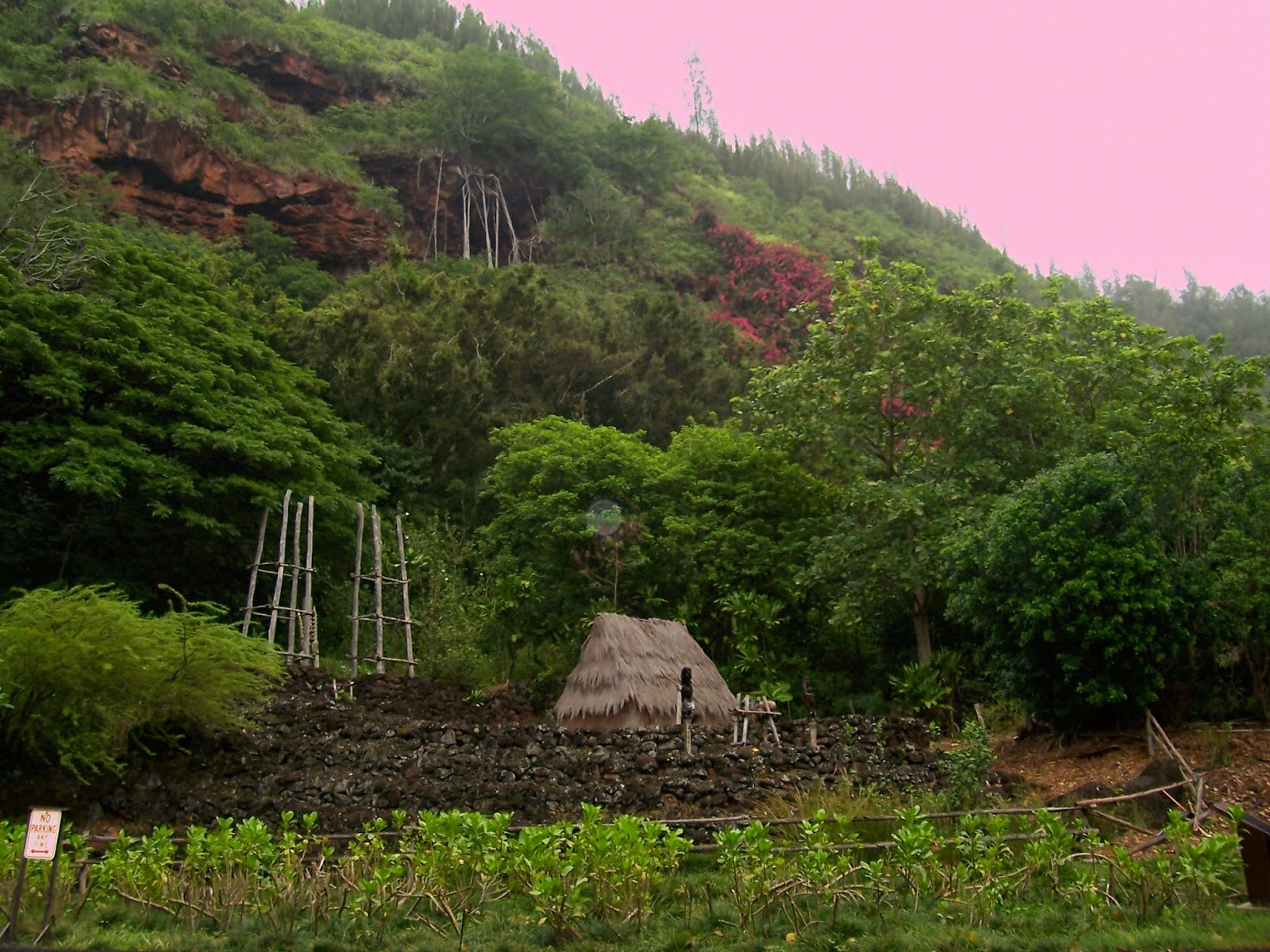
Waimea where his ancestors had lived since the time of Pa’ao. Hale o Lono heiau is right outside the entrance to the botanical gardens.
The valley has been through a series of owners, and finally
OHA has complete possession, caretaking the botanical gardens and turning the
valley into a Hawaiian experience.
The grass houses are being rebuilt. I was particularly interested in the ladder—quite ingenious,
actually.
In the park are wondrous plantings from Hawaii and around
the world. At the end of a three quarter mile walk is the waterfall. Even though the water was still murky
from recent rains, the lifeguards are stationed at the pool below the
waterfall, ready to help people on with their life vests, which are now
required after there had been a couple of people who didn’t make it back to
shore. As the lifeguard helped me on with my swim vest, I kidded him about the mo’o grabbing people, but he pretended
not to hear me, just saying, “Be careful and stay away from the left
side…falling rocks, you know.” So I eased myself into the refreshing pool,
paddled across the pond to the waterfall, said my harvest prayers, and paddled
back.
The Picture I Did Not Take
After we had wandered the gardens for several hours, I asked my
friend Karen (a relative newcomer to the island) if she wanted to see the
sacrificial heiau, Pulu o Mahuka, on
the top of the ridge. We drove up the hill, then down the road and parked the
car. Karen went over to the plaques that explain the surroundings and was
reading the information. A plastic bag floating in the breeze captured my
attention. I was not the only one
looking at the floating plastic; it had also captivated the attention of a very
large black pig. I quickly surveyed our situation: there was a rock wall
between us and the pig, but pigs
(even a fat pig) can outrun a person. I used my rusty geometry calculations to
measure the angle of the pig to the car, and the distance from the people to the car…and realized
that if the pig got it in her mind that we were worthy of her attention, she could beat us to the car. “Eh…Karen…” I said, not
wanting to alarm her, “there is a pig over there. They can be dangerous. Let’s
very calmly move toward the car… just in case.” It was only when we started to
move that the pig noticed us—and came to the edge of the rock wall. When the
sow realized we were moving away from her—and not coming toward her, she
halted. As we watched from the safety of the car, she went back to her
pineapple.
People are asked to stay out of the temple, but
they leave offerings near the fence at the upper end of the heiau. I, myself, have been known to leave a flower, a coin, or a
piece of fruit by the hole in the barbed wire fence. Someone had wrapped a
dendrobia orchid lei around the
fencepost. On the ground the hog was wrestling with a large pineapple. She
picked it up by the green, prickly end—and dropped it when it poked her in the
eye. She picked it up again—and dropped it. Finally she pushed the pineapple
around with her snout, picked it up by the ‘meat’ end, and trotted off through
the hole in the fence to the jungle.
I laughed out loud. “People think the gods eat the fruit,” I chuckled.
“And really the pig gets it!” It
was only after I was driving away that I realized I should have pulled out the
camera and gotten a picture of the pig! It is only the third pig I’ve ever seen
in Hawaii—counting the boar I saw strapped to a pickup hood one Sunday
afternoon when the hunters and the barking dogs in the back announced their
kill to the neighborhood.
The next day, on my way over the pali, I saw two smaller--again black--porkers by the
side of the road. They were not big enough to have been living on their own, so
I surmised the momma must have not fit through the fence, but was watching from
the safety of the jungle nearby.
Two pig sightings in less than 24 hours?! How
could that be? I went to my library to research Hawaiian culture and learned more about
Lono, the god of the rainy season. In one of his physical manifestations he
presents as an all black pig, pua’a hiwa.
In his mythological human form, he is Kamapua’a, the pig god who was one of Madame Pele's lovers. And
so, I understood that my prayers of thanksgiving had been acknowledged.
Saturday, January 4, 2014
New Year's offerings
I took a tour to show a friend some sacred sites. Here are the offerings people left for the New Year.
Ulupo heiau
Pu'u o Mahuka
Pu'u o Mahuka
What a mess for someone to clean up! The offshore wind was starting to blow and the fake paper money was traveling....
Ahupua'a
Jack Daniels at Kukaniloko
Keaiwa Heiau
Tuesday, November 5, 2013
Kaupo and Pi'ilanihale Heiau
My intention was to go out to Nu'u
and beyond—to the coconut grove where Kekaulike lived. Sahlins and Kirch claim
that whole area—from Nu’u to Kaupo--was the largest sweet potato growing area
in the islands because of the soil from the alluvial fan spread down the
mountainside from the Kaupo Gap. I had thoroughly intended to explore the
area--and actually got out of the car and took some photos at one point, but I
ended up getting back in the car and continuing. The road to Hana winds around the
coastline--very narrow in some places with signs that say
"Honk" before you venture around a sharp corner/boulder and run smack
into an oncoming vehicle.
I stopped on the bridge for a picture of the
waterfall--surprised when I later realized it was the only waterfall I was to
really see all day. When I mentioned it, I heard that there has been a drought
and that the usual waterfalls all along the windward coast of Maui were barely
trickling.
I stopped to eat my egg salad sandwich at Waianapanapa State Park but I didn't even get out of the car--something kept pressing me to go on down the road. I passed the sign for Kahanu Botanical Gardens and said, "Hey! That's where Pi'ilanihale Heiau is!" And I turned around. I drove down the road, not stopping at the lava tube but going straight to the gardens. I got out of the car to pay and ended up chatting with the nice lady. Finally she said, "You'd better get going."
I drove down the cement trail to where the cars
park and was taking my time strolling through the gardens--looking at the red
sugar cane--wondering how and when I was going to see the heiau. I looked up and actually had one of those "Oh My
God!" moments. That rock structure is enormous! In my travels I've not
seen anything like it--I've seen heiaus
that have been reconstructed--Puukohala comes to mind--up there on the side of
the hill at Kawaihae--that has been rebuilt with the help of the National Park
Service. Although grand, it does not compare to Pi'ilanihale--which has stayed
and has been cared for by the Pi'ilani family.
I wanted to see if I could get the
whole length of the structure in one picture and walked out to the lawn, but
even then it was not possible.
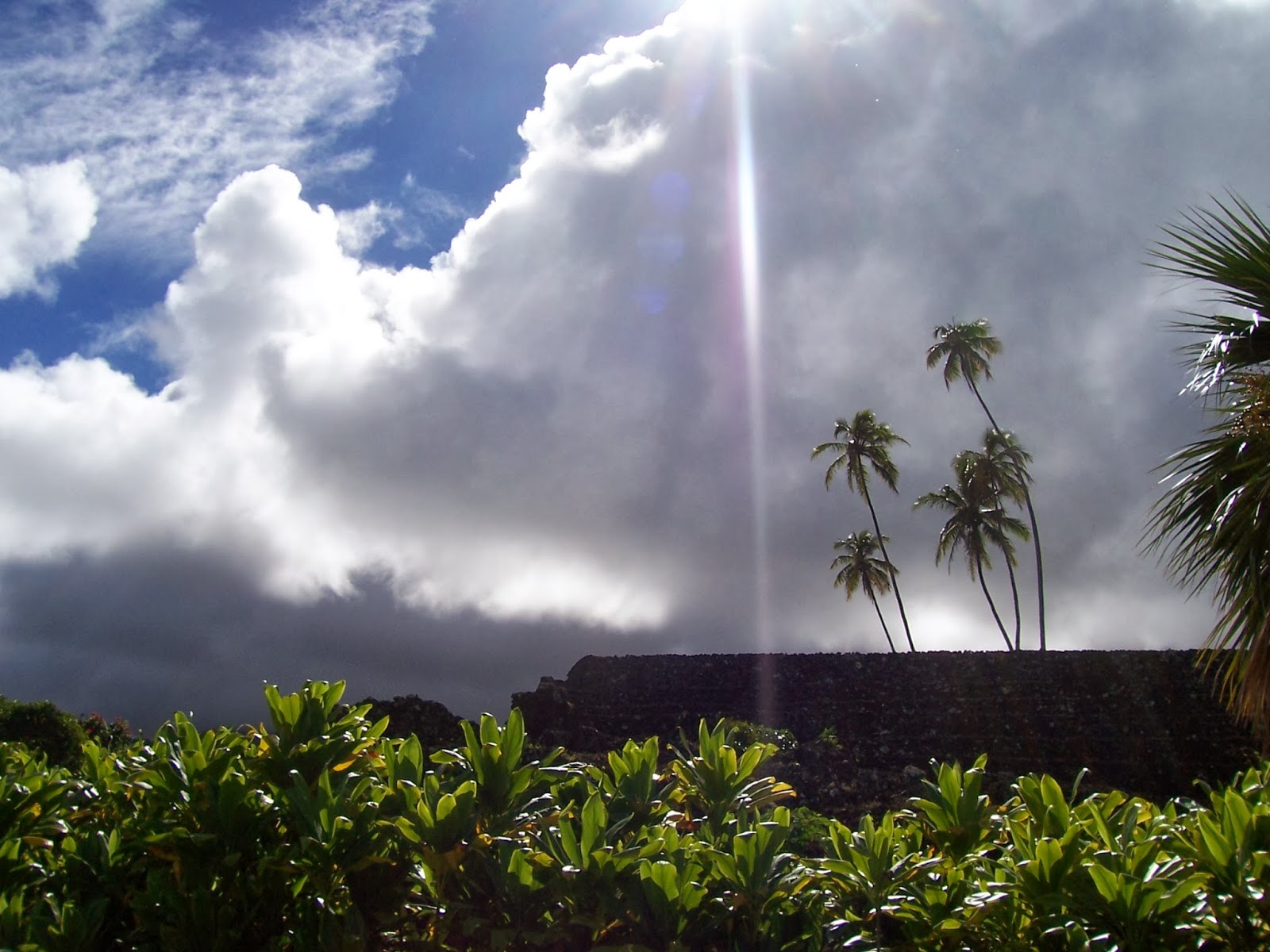
The clouds were rolling off the slopes of
Haleakala, creating dazzling back-lighting opportunities. I could almost hear
the pahus, almost feel the ground
shake the closer I got to the heiau.
I could imagine cloaked chiefs coming to the edge and peering down at me. The
air was still--almost like the rocks absorb the noise--and yet it felt like the
drums and chanting had just stopped and the air was still vibrating.
I peered into the canoe shed, took
one last look at the heiau and felt a
strong hand in my back, pushing me toward the car.
The rays from between the grey clouds made
picture taking a challenge. I kept shielding the lens with my left hand.
Finally the spirits moved my hand so I could get the shot they wanted me to
take.
I literally had shut the car door and the rain beat down on the roof and windshield--the gods had been waiting for me to get in our of the rain and turned on the faucet the moment I was safe. I laughed out loud--and thanked them for keeping me dry. The rain was pounding down so hard I could barely see the cement path--rain like I've only seen a few times before--a wall of water--like standing behind the waterfall.
Saturday, August 17, 2013
Tuesday, July 9, 2013
Pohaku Ka Luahine
A beautiful summer morning on the hike up Moanalua trail in
Kamana Nui Valley. There is a
little park at the trailhead.
Pueo-hulu-nui is where the owls of Kauai and Niihau gathered.
This fireplace is on the left side of the road, just a
little way up the hill. Nothing remains of the Douglas Damon house site except
the fireplace and a small stone table.
There are several stream and bridge crossings on the way up
the valley. The Hawaiians said
this pool had healing qualities and came here to bathe when they were
recuperating from an illness.
These guardian rocks mark the way along the path. There are more guardian rocks near the actual stone. Along the way I heard humming--an industrial sound. Since I was away from civilization, I couldn't figure out what I was hearing. On the way back, I noticed the power wires strung across the valley. The noise was coming from the wind in the wires.
The name Pohaku Ka Luahine means Stone of the Old Woman. One tale told about
this rock is that a child cried one night when a kapu was on at the heiau
at the mouth of the valley. The consequence of anyone making noise during a
ceremony was death. The child’s grandmother grabbed the infant and ran up the
valley to the area called Kahukomo and hid behind the rock. Warriors searched
for the woman and child but did not find them. After a few days, the kapu was lifted and they were able to
return to their home.
The boulder is carved with petroglyphs, most of which are
now so worn they are hardly visible.
Monday, June 11, 2012
Maui No Ka Oi
I took my time and drove down to Nu’u Bay. I had been there a few years ago and had always intended to get back and spend
some time. There was a large village of fishermen that lived there at one time:
King Kekaulike and afterward, his son Kamehamehanui, both were in residence at
different times. I found the
petroglyph field easily and began photographing. Was it the light, the squall
that was brewing or the fact that the images had actually weathered that much
in just a few short years? Whatever the reason, they were worn—the whole place
was “worn”—just plum worn out. The sadness in the air, palpable. This particular petroglyph caught my
eye because it was the one that looked almost alive. Did its sense of being
alive come from the way it had been drawn on the rock—had the artist really
intended it to look so alien? Whatever it was, it stared at me with big round
eyes—and stared and stared. I could hardly bring myself to move; I was
transfixed for I don’t know how long.
I went on down to the rocky beach. The wind was whipping up
the waves and when I looked to the left, I saw the squall racing toward
me. I snapped a couple of pictures
and shoved my camera back in its case because the rain was upon me. In seconds
I was drenched. The keawe thicket
beckoned and I crawled under the branches to get out of the worst of the rain.
I stumbled through the grove until I found the trail again. I looked down and saw blood running down my arm, mixed with rainwater and sweat. It looks much more dramatic than it was. When I got back to the car, I wiped my arm off with a Starbucks napkin and examined the small nick I’d gotten from the keawe thorn. Yes, I had paid in blood, but it was a small price.
Every time I looked in my rear view mirror, I could see the squall chasing me up the coastline. I drove for a few miles and then stopped to take pictures of Kahaleamakani Gulch. The road crew had put up the rock nets to protect what few travelers venture into these parts. Although I understand the danger falling rock represents (and almost was the victim of a boulder on the road one night near Hanauma Bay), I still look at those nets as putting the rocks behind bars.
When I got to the other side of the Gulch and up to a pull-out, the wind
pushing the squall was right in my face. The closer I got to the edge of the
cliff, the stronger the updraft until it was all I could do to stand up in
order to take this picture. Below
there were lots of stone walls—windbreaks for the fishermen who camp down there in better weather. Just
that few minutes of picture taking and the squall had caught up with me again.
I looked over to the slopes of Haleakala—which are behind
the clouds that were scuttling along—seemingly as fast as I could drive. I knew that somewhere behind all those clouds
there was a 10,000 foot mountain.
This is a small section of the King’s Road. Every year, the
king would make his rounds of the island, collecting taxes. As I flew in from Honolulu, I was also
able to make out part of the king’s road around the Lahaina area. It’s easy to
see once you know what you’re looking for.
I had always wanted to find the petroglyphs behind Buzz’s
Steakhouse at Ma'alaea Bay. First I had to hop the traffic railing and wait
until both lines of traffic allowed me to scurry across the road. I walked
straight up the hill to the water tower. It was hot, the sun was beating down
on my head (I hadn’t worn a hat because I figured I’d just be fighting the wind
for my hat), and I had only a small bottle of water. The road went up at better
than a 25 degree angle and my old body felt it! I sat down and rested in the middle of the road, watching that same
squall coming up the coastline. I
found some petroglyphs, but I’m not entirely certain they are the ones I’ve
read about. Nonetheless, here is
one.
The next day I drove my friends up to the crater. Allison hadn’t been up there for years;
D, the old horseman, used to take the tourists down in the crater in 12 person
trail rides. At about 8,000 feet Allison
said she was feeling funny. By the time we got out of the car at a little over
10,000 feet, she was dizzy. We walked up the trail to the top of the rim. This
is the Kaupo Gap—the place the last lava flowed out of the crater. In the
distance is the Big Island—hidden in the clouds.
This is the Ko’olau Gap, the other flow went down the
windward side. When we were able
to sit down on the boulder and get out of the wind, we tarried long enough to
get a sense of the rarified air and the intense quiet (when the tourists
weren’t jabbering). I had a small bag of potato chips in the car, and the bag
swelled up with air until I thought for sure it would explode. I wanted to open
it up there—just to see what would happen—but D said, “You’d have chips
everywhere!” so I decided I’d watch the bag decompress on the way down. I was busy driving and forgot to look
until we were down to about 3,000 feet, and by that time it was almost back to
normal.
Subscribe to:
Posts (Atom)